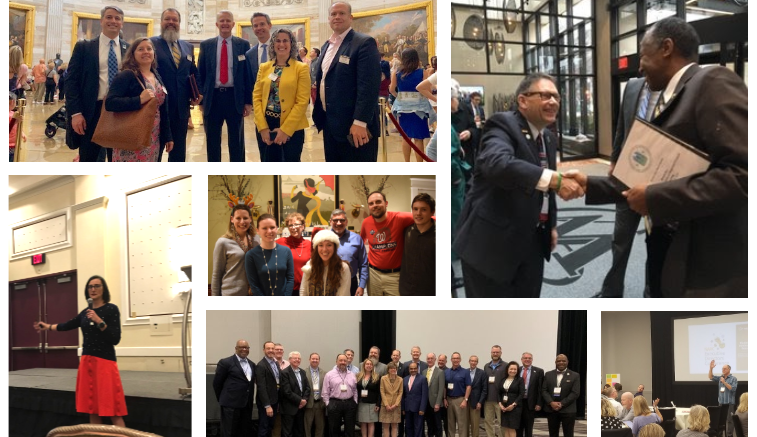
2019: A Year in Review
On behalf of the NARC staff, thank you for all of your support during the past year. Here is a quick look back at all of our successes in 2019.
On behalf of the NARC staff, thank you for all of your support during the past year. Here is a quick look back at all of our successes in 2019.

How can you help the Census Bureau prepare your region for the upcoming 2020 census? Here are a few actionable tips to get started today!

Last week the Environmental Protection Agency (EPA) held its second annual America Recycles Summit and inaugural Innovation Fair to highlight national efforts being taken to address major challenges facing the U.S. recycling system.

The National League of Cities (NLC) in partnership with the Public Technology Institute (PTI) has recently released a new guide: Protecting Our Cities: What Cities Should Know About Cybersecurity during cybersecurity month in October. This document was designed to help communities, regions, and local officials better prepare for cyber-attacks before they happen. Despite popular belief,

Over the next several weeks, the House and Senate will be working on drafting a final fiscal year (FY) 2020 omnibus appropriations bill in hopes of meeting the November 21 continuing resolution deadline. As is so often the case, the House and Senate Labor-Health and Human Services-Education (Labor/H) appropriations bills differ. Overall, the House FY
As the cost of recycling is escalating for many local governments, regional councils are working toward solutions.

In July of this year, California and four major automakers, BMW, Ford, Honda, and Volkswagon, reached an agreement over a framework for setting Corporate Average Fuel Economy (CAFE) standards and vehicle greenhouse gas (GHG) emissions standards through the year 2026. Following the announcement of the framework, the Trump administration began pushing back against California and the four automakers.

In 2019 having access to internet is no longer an option. Job applications, student homework, ecommerce, small business billing, and even conversations with friends and family require access to basic internet. Unfortunately, millions of Americans still lack sufficient internet access.

With new backpacks and school supplies in tow, students across the country are heading back to school. They probably are not thinking about the regional planning that went into creating the transportation system that brought them to school. Some regional councils are trying to teach the next generation that even being as young as they are, they can significantly impact their communities.

Tracking Greenhouse Gas (GHG) emissions and mitigation efforts is no easy task. Accurate data collection may require decades worth of data points and many seemingly noncontributing factors may skew results. Contribution Analysis tools can help regions in their GHG inventory efforts.

August is National Water Quality Month, a perfect time to take a look at some of the ways that regions can use the Clean Water State Revolving Fund (CWSRF) and Drinking Water State Revolving Fund (DWSRF) to support local water infrastructure improvements.

The push for transportation reauthorization has begun, with approximately 15 months before the current authorizing legislation – the FAST Act – expires. This early start to the process can be ascribed to two systemic challenges Congress faces in getting a final bill across the finish line.

Many of NARC’s members are acting as regional partners to combat major flooding through a complex consortium of stormwater user fees and taxes, green infrastructure, zoning regulations, long-term stormwater designs, and flood risk mapping tools.

Read about some of the programs that regional councils across the US are working on to help tackle the impacts of the affordable housing crisis in their regions.

As the debate over adding the citizenship question to the 2020 census rages on, concerns over the effects of an undercount in regions across the country remain.

What began as a single city- or county-based job training system some 45 years ago has morphed into a robust, multi-jurisdictional job training system that reflects how and why economies emerge. Going beyond governmental boundaries, this system provides workforce development based on labor markets, economic development areas, local economies, industrial composition, labor force conditions and participation, and much more.